
TCEC & CCRL: How Engines Are Tested
What you’ll learn: How engines are tested and what the ratings mean. Reading time: 7 minutes
When someone says “Stockfish is rated 3600,” where does that number come from? Engines don’t play on Lichess or Chess.com with regular ratings. They’re tested in dedicated competitions with controlled conditions and standardised methodologies.
Two organisations dominate engine testing: TCEC (competition) and CCRL (rating lists). Understanding how they work helps you interpret engine strength claims.
TCEC: Top Chess Engine Championship
TCEC is the premier engine competition. Running since 2010, it’s the closest thing to a World Championship for chess engines.
How it works
TCEC runs continuous seasons, each lasting several months. Engines compete in divisions based on strength:
- Division 4: Weakest entrants, proving ground for new engines
- Division 3: Stronger engines working their way up
- Division 2: Serious contenders
- Division 1: Top tier below the superfinal
- Premier Division: The elite, typically 8 engines
- Superfinal: The top 2 engines from Premier play a long match
Promotion and relegation happen between divisions based on results. Win your division, move up. Finish last, move down.
Testing conditions
TCEC runs on powerful standardised hardware—currently high-end multi-core CPUs with substantial RAM. All engines run on identical machines, eliminating hardware advantages.
Games use long time controls (typically 60 minutes + 10 seconds increment), allowing engines to reach serious depth. Openings come from a curated book to ensure variety and test engines across different position types.
Every game is broadcast live with real-time analysis. The community watches, debates, and occasionally despairs when their favourite engine loses.
Why TCEC matters
TCEC results are the gold standard for engine strength. When Stockfish wins TCEC Season 25, that’s meaningful—it beat the best competition under controlled conditions.
The superfinal results, in particular, show clear head-to-head strength differences. A 55-45 result over 100 games is statistically significant; the winning engine is genuinely stronger.
Following TCEC
- Website: tcec-chess.com
- Live games: Broadcast 24/7 during seasons
- Archives: All games available for download
CCRL: Computer Chess Rating Lists
While TCEC is a competition, CCRL is a testing group that maintains rating lists. They run thousands of games between engines and calculate Elo ratings.
The rating lists
CCRL publishes several lists:
- CCRL 40/15: 40 minutes + 15 seconds increment per game
- CCRL Blitz: 2 minutes + 1 second increment
- CCRL FRC: Fischer Random (Chess960)
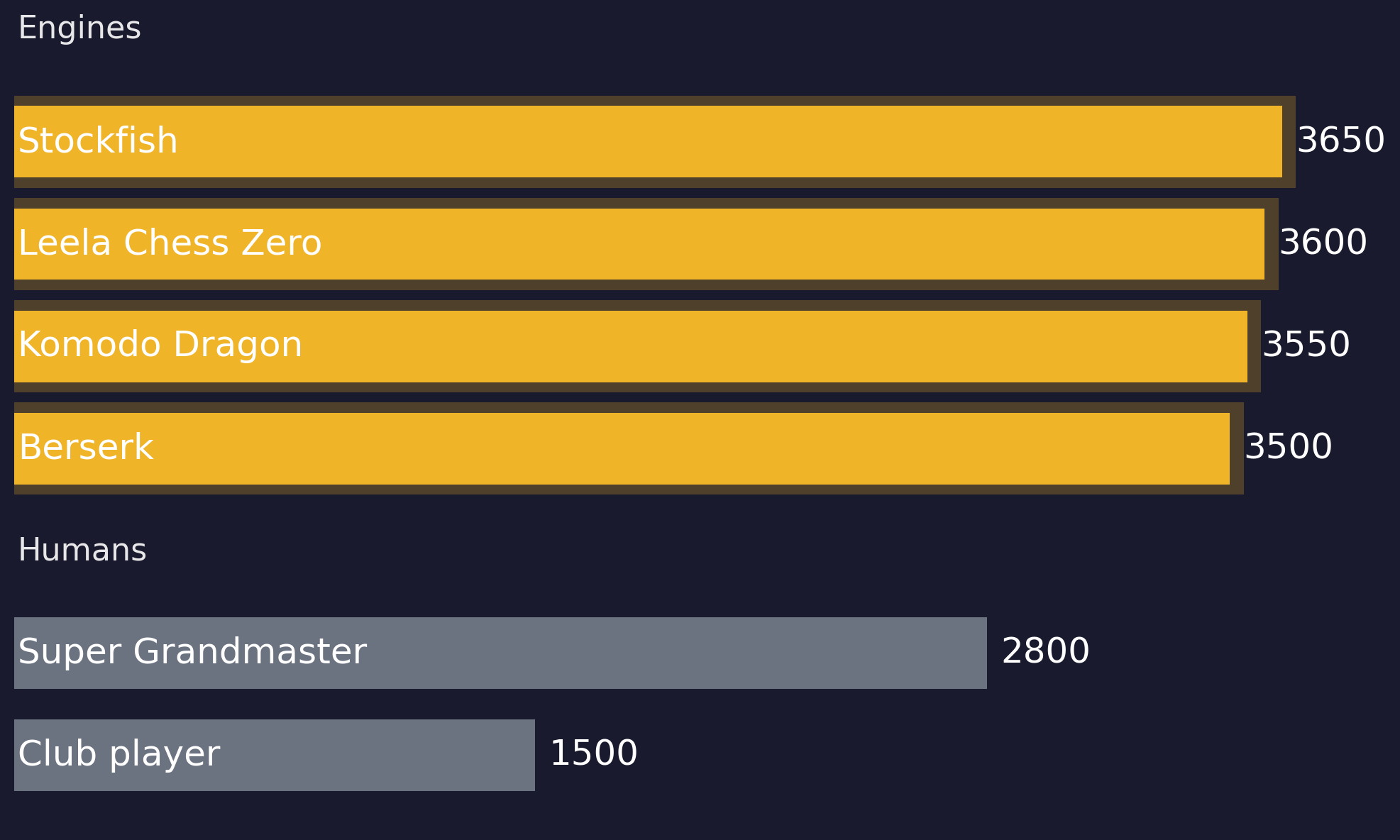
The 40/15 list is the main reference for engine strength. Current top ratings (as of early 2025; check CCRL for current standings):
| Engine | Approximate Rating |
|---|---|
| Stockfish | ~3650 |
| Leela Chess Zero | ~3600 |
| Komodo Dragon | ~3550 |
| Berserk | ~3500 |
Ratings fluctuate as new versions are tested.
Methodology
CCRL tests engines on standardised hardware and opening books. Each engine plays hundreds or thousands of games against other engines. Ratings are calculated using Elo formulas based on game results.
The testing pool includes engines of all strengths, from Stockfish down to engines rated 2000. This breadth helps establish accurate relative ratings.
Interpreting CCRL ratings
CCRL ratings are relative to other engines in their pool, not to human players. A 3600-rated engine isn’t “3600 Elo in the FIDE sense”—it’s 3600 relative to other programs.
That said, CCRL ratings roughly correlate with playing strength against humans. An engine rated 3000 on CCRL would destroy any human player. An engine rated 2200 would play at roughly club level.
Important caveat: Ratings depend on testing conditions. An engine rated 3600 at 40/15 time controls might be relatively weaker at bullet (where speed matters more) or relatively stronger at longer controls (where depth matters more).
Other testing groups
CEGT
Computer Engine Grand Tournament. Similar to CCRL but with different testing conditions. Their ratings are generally comparable but not identical.
Stefan Pohl’s lists
Individual tester who publishes engine ratings with different methodologies. Respected in the community for thorough testing.
SPCC
Another testing group with their own rating lists. Multiple independent testers help validate results—if an engine performs similarly across CCRL, CEGT, and SPCC, the rating is probably accurate.
What ratings mean (and don’t mean)
Ratings are contextual
An engine’s rating depends on:
- Time controls
- Hardware
- Opening book
- Opponent pool
Stockfish at 3650 on CCRL hardware might be relatively stronger or weaker on your laptop. Ratings are benchmarks, not absolute measures.
Small differences are noise
A 10-Elo difference between engines is within measurement error. You need ~30-50 Elo difference to be confident one engine is meaningfully stronger.
Don’t obsess over version 17.1 being “5 Elo stronger” than 17.0. Play either one; you won’t notice.
Ratings don’t capture style
An engine rated 3550 might be better or worse than its rating suggests in specific position types. Leela might outperform its rating in quiet strategic positions; Stockfish might exceed its rating in tactical complications.
Ratings are averages across many games and positions. Your mileage may vary in specific situations.
Using ratings practically
Choosing an engine
For analysis, use the strongest engine available—usually Stockfish. Rating differences of 50+ Elo are meaningful; 10-20 Elo isn’t. Chessmate includes top-rated engines like Stockfish and Leela so you can compare their analysis on any position.
Setting sparring strength
If you want to play against an engine at a specific level, CCRL ratings help calibrate. An engine set to play at “2000 Elo” on CCRL should provide club-level opposition.
Evaluating new engines
When a new engine claims to be strong, check its CCRL/TCEC results. Self-reported ratings are unreliable; tested ratings matter.
Understanding engine improvements
When Stockfish releases a new version claiming “+30 Elo,” that’s based on testing against the previous version. It’s a real improvement, validated by thousands of games.
Following engine chess
TCEC
Watch live at tcec-chess.com. Chat with other enthusiasts. Root for your engine.
CCRL
Check the lists at ccrl.chessdom.com. See where your favourite engine ranks.
Forums
- TalkChess: The main forum for engine developers and enthusiasts
- Reddit r/ComputerChess: Discussion of engine news and developments
- Chess.com forums: Engine discussion threads
Why follow?
Even if you don’t care about engine competitions specifically, following TCEC/CCRL helps you:
- Know which engine versions are current
- Understand strength differences between engines
- Appreciate the engineering behind chess programs
- See chess played at the absolute highest level
Engine games are often more instructive than human games—perfect tactics, deep strategy, no blunders. Watching Stockfish dismantle a position teaches you things human games can’t.
Summary
TCEC is the engine World Championship—elite competition under controlled conditions. Results here are the gold standard.
CCRL provides rating lists based on thousands of tested games. Use their ratings to understand relative engine strength.
Ratings are contextual (hardware, time control, opponents) and shouldn’t be over-interpreted. But they’re the best measure we have for engine strength, and following the competitions is genuinely interesting.
Stockfish has dominated recent TCEC seasons. Leela provides the main competition. Everyone else is fighting for third place.