
Tablebases: Perfect Endgame Play
What you’ll learn: Perfect endgame knowledge for positions with 7 or fewer pieces. Reading time: 8 minutes
Tablebases are databases of solved chess positions. For any position with 7 or fewer pieces, the tablebase knows the exact result—win, draw, or loss—and the optimal path to achieve it. No calculation needed. No uncertainty. Mathematical truth.
This is the only area of chess where perfection is possible, and it changes how you think about endgames.
Use them right now
You don’t need to download anything. Online tablebase probes are free and instant:
- syzygy-tables.info — Enter any position, get the exact verdict
- Lichess — Built into the analysis board; tablebase positions show exact results
- Chess.com — Available in the analysis board
- Chessmate — Integrates tablebase lookups automatically
For positions with 7 or fewer pieces, these tools show whether the position is won, drawn, or lost—and the best move. No more guessing whether an endgame is winning.
What tablebases tell you
The result
Every position has exactly one of three verdicts:
- Win: The side to move can force a win with perfect play
- Draw: Neither side can force a win; best play holds
- Loss: The side to move loses with perfect play from the opponent
This is objective truth. If the tablebase says a position is drawn, no amount of engine analysis will find a win—there isn’t one.
DTZ: Distance To Zeroing
DTZ counts the minimum moves to an irreversible change (capture or pawn move). This tells you how to make progress.
A position might be “winning” but have DTZ 97—meaning you need 97 precise moves before something irreversible happens. That’s useful to know: the win is there, but it’s long.
Practical implications
Know your winning endgames
Tablebase knowledge tells you which positions to aim for:
- KQKR: Queen wins, but can take 30+ moves. Avoid if you’re short on time.
- KRKB: Rook wins against bishop. Usually straightforward.
- KRKN: Rook wins against knight. Can be tricky; some positions take 70+ moves.
- KBNK: Bishop and knight mate. The hardest common winning endgame—requires technique.
Know the draws
Equally important: knowing which positions draw lets you simplify confidently.
- KBKB: Same-coloured bishops is usually draw (fortress possible)
- KRK vs KR: Drawn without pawns unless you can win the exchange
- KNNK: Two knights can’t force mate against lone king (though can win with help)
Using tablebases for study
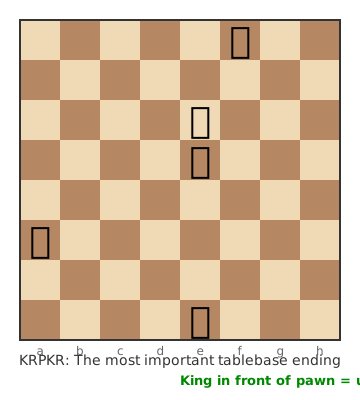
- Set up a position you’re learning (e.g., KRPKR with a passed pawn)
- Check the tablebase verdict
- Try to find the winning/drawing moves yourself
- Compare your moves to the tablebase’s recommendations
This builds intuition for which positions are winning and which are drawn—knowledge that helps you steer toward or away from specific endgames.
Going deeper
Everything above is what you need for practical use. The sections below cover technical details and advanced topics.
Syzygy format
Several tablebase formats exist, but Syzygy (pronounced “SIH-zi-jee”) is the modern standard. Created by Ronald de Man, Syzygy tables are:
- Compact (much smaller than older formats)
- Fast to probe
- Supported by all major engines
Syzygy uses two file types:
- WDL files (.rtbw): Store Win/Draw/Loss information
- DTZ files (.rtbz): Store Distance To Zeroing (moves to capture or pawn push)
For analysis, you want both. WDL tells you who’s winning; DTZ tells you how to make progress.
6-piece vs 7-piece
Tablebases are categorised by piece count (including kings):
6-piece tablebases (~150 GB)
- Cover all positions with up to 6 pieces total
- Examples: KQK, KRKN, KBBKN, KRPKR
- Practical for most users
- Fast to download and store
7-piece tablebases (~140 TB)
- Cover all positions with up to 7 pieces
- Includes complex endings like KRPPKRP
- Require specialised storage
- Mostly used by correspondence players and engine testers
For most analysis, 6-piece tables are sufficient. You rarely reach 7-piece endings where perfect play matters, and engines handle them well anyway.
Downloading locally
For offline access or engine integration:
6-piece Syzygy:
- Size: ~150 GB (WDL + DTZ)
- Download from: tablebase.sesse.net
- Fits on a standard SSD
7-piece Syzygy:
- Size: ~140 TB
- Impractical for most users
- Available through torrents and specialised sources
After downloading, configure your engine’s SyzygyPath setting (see Engine Settings) to point at your tablebase directory. The engine will:
- Probe the tablebase when reaching positions with few pieces
- Display exact verdicts instead of evaluations
- Play perfectly in tablebase positions
This matters less for analysis (online probes work fine) and more for engine competitions where perfect endgame play is required.
Cursed wins and blessed losses
Some positions have counterintuitive verdicts:
Cursed win: A position that’s winning according to the tablebase, but the 50-move rule would trigger before mate if the defender plays perfectly. Practically winning, but technically drawn under FIDE rules.
Blessed loss: A losing position where the defender can invoke the 50-move rule before being mated. Technically saved, though objectively lost.
These matter mainly in correspondence chess and extreme endgame studies. In practical play, the 50-move rule rarely comes up in tablebase positions.
Famous tablebase discoveries
Tablebases have resolved long-standing endgame questions:
KQK vs KRR: Intuitively, the side with queen and knight seems to have chances. Tablebases proved it’s a draw with perfect defence—though the defence is far beyond human capability.
KBBKN: Two bishops vs knight. Tablebases showed this is a win, but can require over 60 moves to convert. The winning technique was unknown to humans before tablebases computed it.
KRPKR: Rook and pawn vs rook. The most common practical tablebase ending. Many positions are draws that look winning, and vice versa. Tablebase-trained technique in this ending separates strong players from average ones.
Summary
Tablebases give you perfect endgame knowledge: not “probably winning” but “definitely winning in 43 moves.” For positions with 7 or fewer pieces, the game is solved.
Use tablebases to:
- Verify endgame evaluations
- Study winning techniques
- Know which endings to aim for or avoid
- Stop calculating when you can look up
Online probes are free and instant—just visit syzygy-tables.info or use the tablebase feature in your favourite chess site. There’s no reason not to use them.