
Using Engines for Opening Preparation
What you’ll learn: Using engines for repertoire building without falling into traps. Reading time: 10 minutes
Engines have transformed opening preparation. Lines that GMs spent months analysing can now be checked in seconds. But this power is easy to misuse. Many players hurt their results by blindly following engine recommendations in openings—moves that are objectively best but practically terrible.
This guide explains how to use engines for opening work without falling into the common traps.
The engine line trap
Here’s the typical mistake: You reach a position in your opening, fire up Stockfish, and play whatever it recommends. The engine says 1.e4 e5 2.Nf3 Nc6 3.Bb5 a6 4.Ba4 Nf6 5.O-O Be7 6.Re1 b5 7.Bb3 d6 8.c3 O-O 9.h3 is best, so that’s what you play.
The problem: you’ve memorised moves without understanding them. When your opponent deviates on move 7, you’re lost. You don’t know why 9.h3 was played, so you can’t find the right plan when the position changes slightly.
Worse, the engine’s top choice is often the sharpest, most forcing line—requiring precise follow-up for many moves. The second or third choice might score better in practice because it’s easier to play and harder to go wrong in.
What engines are good at
Finding refutations
If a line is tactically flawed, the engine will find it. This is the engine’s greatest value in opening preparation: checking that your intended moves don’t lose to concrete tactics.
Before playing a gambit or accepting a sacrifice, verify with the engine that you’re not walking into a forced loss. Before playing a sharp theoretical line, check that recent developments haven’t refuted it.
Evaluating specific positions
Once you reach a position you’re considering adding to your repertoire, the engine tells you if it’s objectively sound. An evaluation around equal (±0.30) means the position is playable. If the engine says you’re already -0.80 out of the opening, you might want a different line. (See Understanding Evaluations for more on interpreting these numbers.)
Checking novelties
Found an interesting move that isn’t in the database? The engine quickly tells you if it’s sound or if there’s a refutation you missed. This saves hours of manual calculation.
What engines are bad at
Long-term compensation
Engines struggle with positions where one side has long-term strategic compensation for a material or structural deficit. Classic example: sacrificing a pawn for lasting pressure against a weak square complex. The engine might show -0.50 for 30 moves before finally recognising the compensation is real.
In openings, this means engine evaluations of sharp gambits are often misleading at lower depths. The engine sees “Black is a pawn up” and doesn’t fully appreciate White’s lead in development and attacking chances.
Practical difficulty
The engine doesn’t know that a position is hard to play. A line might be objectively equal but require 15 moves of precise defence where one slip loses. Another line might be slightly worse objectively but give you easy moves and put practical pressure on your opponent.
The engine rates these positions similarly. Your results won’t be similar.
Human tendencies
Engines don’t know that club players consistently mishandle certain structures. The Isolated Queen’s Pawn (IQP) is objectively fine for both sides—but if your opponents always play passively against it, an IQP position might be worth seeking.
Similarly, engines don’t know that certain positions are “tricky” or lead to practical mistakes. The London System isn’t objectively impressive, but it creates positions where Black has to know specific plans to equalise, and many players don’t.
A practical workflow
1. Start with human games
Before touching an engine, look at games in your intended line. Use a database (Lichess, Chess.com, ChessBase) to find master games. Watch how the positions develop. Notice the typical plans, piece placements, and pawn breaks.
This gives you understanding. You’ll know why moves are played, not just what moves to play.
2. Identify critical positions
As you review games, note positions where the game could go different directions. These are the branch points in your preparation tree.
3. Use the engine to verify
Now bring in the engine. Check that your intended lines aren’t tactically flawed. Look at the critical positions and see how the engine evaluates different options. Set MultiPV to 3 or 4 to compare alternatives side-by-side.
If the engine says your preferred move is 0.3 pawns worse than the top choice but leads to positions you understand, that’s often the right choice.
4. Check both sides
Prepare your opponent’s best responses, not just your own moves. What’s the main line against your system? What sidelines might surprise you? The engine helps you see what your opponents might throw at you.
5. Focus on ideas, not moves
Don’t memorise 20 moves of theory. Memorise the key ideas at critical moments. When you understand why the knight goes to d5 or why the pawn push to f5 works, you’ll find the right moves even when theory ends.
Building a repertoire: depth vs breadth
You have limited time. Do you learn 15 moves deep in one line or 8 moves deep in three lines?
For most players, breadth beats depth. Here’s why:
- Your opponents will deviate early. Knowing moves 15-20 is useless if they play something else on move 6.
- Understanding multiple structures makes you a better player overall.
- You can always deepen later once you’ve played positions and know what you actually face.
Go deep only when:
- You play a sharp theoretical line where knowing more is critical (e.g., certain Sicilian variations)
- You face the same opponents repeatedly who know the theory
- You’re preparing for a specific opponent in a serious game
For club players, knowing the first 8-10 moves of several sensible lines is much more valuable than knowing 20 moves of one sharp line.
When engine lines are wrong for you
Consider this position from the Scotch Game:
1.e4 e5 2.Nf3 Nc6 3.d4 exd4 4.Nxd4 Nf6 5.Nxc6 bxc6 6.e5 Qe7 7.Qe2 Nd5 8.c4
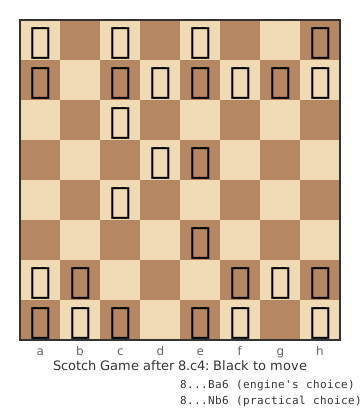
The engine’s top choice for Black is often 8…Ba6, leading to sharp play with opposite-side castling. It’s objectively best. It’s also a nightmare to play without deep preparation—one wrong move and you’re lost.
The second choice, 8…Nb6, is 0.1-0.2 pawns worse but leads to solid positions where Black has fewer ways to go wrong. For most players, 8…Nb6 is the better practical choice.
The engine doesn’t know this. You have to.
Signs an engine line might be wrong for you:
- The evaluation stays close only with long forced sequences
- The resulting positions require very precise play
- The line is heavily theoretical with sharp sidelines
- You don’t understand why the moves work
Tools and techniques
Database + Engine workflow
- Open a database (Lichess opening explorer, ChessBase)
- Navigate to your opening
- Check game statistics: What do masters play? What are the win rates?
- Open the engine alongside the database
- Cross-reference: Does the engine agree with the popular moves? Where does it suggest alternatives?
Chessmate lets you compare how different engines evaluate the same opening position—useful when you want a second opinion on a critical line.
Repertoire building software
Tools like Chessable, Chess Position Trainer, or Chessbook let you build and drill repertoires. Input your chosen lines, then practice until the moves are automatic.
The drilling is important. Opening knowledge you can’t recall under time pressure is useless.
Testing lines
After preparing a line, test it. Play it in online games. See what your opponents actually play. Often they’ll surprise you with moves the database said were rare. Now you know what to prepare.
Summary
Engines are verification tools, not move generators. Use them to check that your lines are sound, not to tell you what to play. Start with human games to understand the ideas, then verify tactics with the engine.
The best opening preparation combines: human games for understanding, engine analysis for verification, and practical testing to see what you actually face.
Don’t play the engine’s first choice just because it’s first. Play the move you understand.