
The Engine Wars: A Brief History
What you’ll learn: From Deep Blue to NNUE—the full history of computer chess. Reading time: 12 minutes
The story of chess engines is a story of obsession, rivalry, controversy, and the relentless pursuit of perfect play. From academic curiosity to world championship drama to open-source triumph, computer chess has seen it all.
The theoretical foundations (1950s)
Chess programming began as a thought experiment. In 1950, Claude Shannon published “Programming a Computer for Playing Chess,” outlining the basic approach that engines still use: generate moves, evaluate positions, search through possibilities.
Shannon estimated that a perfect chess game tree would contain more positions than atoms in the universe. Brute force wasn’t an option. Engines would need to be clever.
A year later, Alan Turing designed a chess algorithm by hand—there was no computer available to run it. He executed the algorithm manually, taking about half an hour per move. It played badly but proved the concept: machines could, in principle, play chess.
Early programs (1960s-1970s)
The first working chess programs appeared in the 1960s:
Mac Hack VI (1967) became the first computer to beat a human in tournament play—a significant milestone, even if the human was a relatively weak player.
Chess 4.x series (1970s) developed at Northwestern University, won multiple North American Computer Chess Championships and achieved an estimated rating of about 2000 Elo by the late 70s—roughly club player strength.
These programs were weak by modern standards, but they established the foundations: alpha-beta search, transposition tables, quiescence search. The basic architecture of chess engines was taking shape.
The commercial era (1980s-1990s)
As personal computers became widespread, commercial chess software emerged:
Sargon (1978) was one of the first commercially successful chess programs, selling millions of copies across various platforms.
ChessMaster (1986) combined decent playing strength with a polished interface, becoming the best-selling chess franchise in history.
Fritz (1991) emerged as the dominant commercial engine, known for its aggressive playing style and strong analysis features. Fritz would remain a major player for decades.
Rebel and Chess Genius competed with Fritz at the top level, and Chess Genius famously defeated Garry Kasparov in a rapid game in 1994—the first time a reigning World Champion lost to a computer under standard tournament conditions.
Engine ratings crept toward master level: 2200, 2300, 2400. Strong amateurs could still beat them, but the gap was closing.
Deep Blue vs Kasparov (1996-1997)
IBM’s Deep Blue project brought chess engines to global attention.
In 1996, Kasparov defeated Deep Blue in a 6-game match, winning 4-2. But the machine won one game—the first time a computer had beaten a reigning World Champion in a classical time control game.
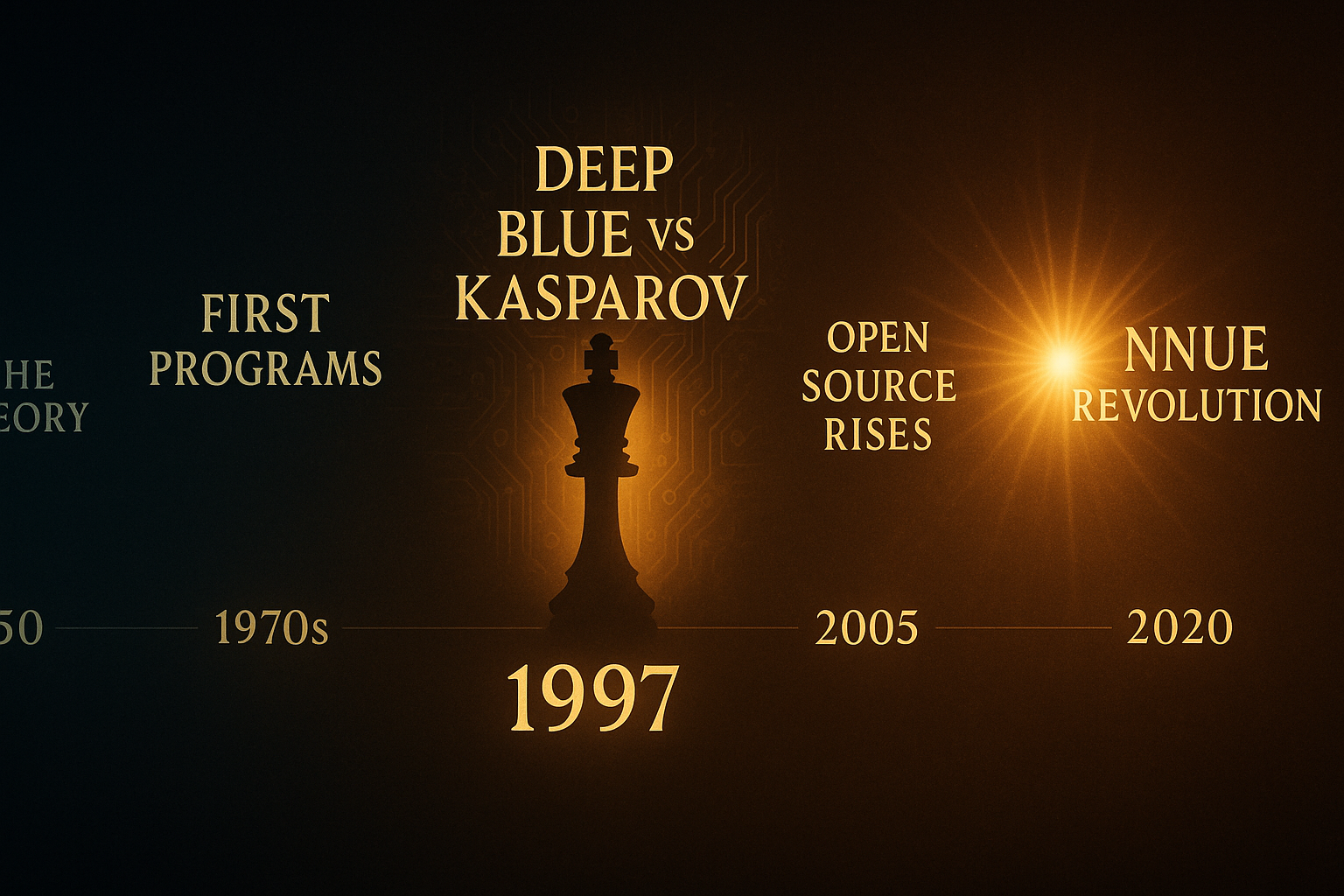
The 1997 rematch changed history. Deep Blue, dramatically upgraded with double the processing power and refined evaluation, won 3.5-2.5.
Game 6 was decisive. Kasparov, playing Black, collapsed in 19 moves—a shocking result that suggested psychological pressure as much as chess weakness. He later accused IBM of cheating, claiming human intervention during games. IBM denied it and promptly retired Deep Blue, never allowing a rematch.
The match was a cultural moment: the machine had beaten humanity’s greatest chess player. Magazine covers proclaimed the dawn of artificial intelligence. Chess would never be the same.
The controversy lingers. IBM’s refusal to play a rematch, combined with secrecy about Deep Blue’s exact workings, fuels conspiracy theories to this day. Kasparov eventually moderated his cheating claims but never fully accepted the loss.
The open-source revolution (2000s)
After Deep Blue, chess engine development fragmented. Commercial engines continued improving, but a new force emerged: open-source.
Crafty (1996) was an early open-source engine that reached master strength. Its creator, Robert Hyatt, made the code public, allowing others to learn and build on his work.
Fruit (2004-2005) shocked the computer chess world by finishing second in the 2005 World Computer Chess Championship—behind the commercial giant Shredder, but ahead of all other commercial engines. When Fruit’s source code was released, it accelerated development across the entire field.
Rybka (2005-2010) dominated the late 2000s, winning multiple world championships. Created by International Master Vasik Rajlich, Rybka was widely considered the strongest engine in the world.
Stockfish emerged in 2008, forked from Glaurung by Marco Costalba and developed openly. At first, it was one strong engine among several.
The Rybka scandal (2011)
In 2011, the International Computer Games Association (ICGA) investigated Rybka and found that it had derived code from both Crafty and Fruit without attribution—a violation of open-source licenses and tournament rules.
The ICGA stripped Rybka of its world championship titles and banned it from competition. Rajlich denied wrongdoing, and the decision remains controversial in the community. Some saw it as justified enforcement of open-source principles; others viewed it as scapegoating the most successful engine.
Regardless of the ethics, the practical effect was clear: commercial engines lost their dominant position. Open-source had proven it could compete at the highest level, and the community rallied around projects like Stockfish.
The rise of Stockfish (2010s)
With Rybka sidelined, Stockfish rose to prominence. Its advantages compounded:
Open development: Anyone could propose improvements. The best ideas from dozens of programmers were integrated.
Fishtest: A distributed testing framework where thousands of games validated every change. No guessing whether a modification helped—the data proved it.
Community momentum: As Stockfish improved, more developers joined. More developers meant faster improvement. The cycle fed itself.
By 2015, Stockfish was clearly the strongest engine in the world. Commercial competitors like Fritz, Houdini, and Komodo couldn’t match the pace of development. Open-source had won.
AlphaZero: The shock (2017)
DeepMind’s AlphaZero didn’t just play chess—it taught itself chess from scratch using reinforcement learning and neural networks. No opening books. No endgame tablebases. No human games in the training data.
In a 100-game match against Stockfish, AlphaZero won 28 and drew 72. It didn’t lose a single game.
More impressive than the result was the style. AlphaZero played creative, almost human-like chess: long-term sacrifices, positional pawn pushes, strategic piece manoeuvres that made sense only many moves later. It seemed to understand chess in ways that brute-force search engines didn’t.
The chess world took notice. Commentators called it “the future of chess.” Some declared traditional engines obsolete.
The asterisks: Stockfish wasn’t running on equivalent hardware (though adjustments were made for time). Stockfish was an older version. The match conditions favoured AlphaZero’s style. The result was real, but the margin might have been exaggerated.
Still, AlphaZero demonstrated that neural networks could play superhuman chess. The question became: could the approach be replicated?
Leela Chess Zero (2018-present)
Since AlphaZero was proprietary, the open-source community built their own version: Leela Chess Zero.
Leela uses the same approach as AlphaZero—Monte Carlo Tree Search guided by a neural network—but trains through distributed computing. Thousands of volunteers donate CPU and GPU time to play training games.
By 2019, Leela was competitive with Stockfish. Not dominant, but close. The neural network approach clearly worked.
Leela’s playing style resembles AlphaZero’s: strategic, patient, sometimes mysterious. It finds plans that Stockfish needs deep search to see. Grandmasters study Leela’s games for ideas.
NNUE: The hybrid revolution (2020)
The final twist came from an unexpected direction: Shogi.
NNUE (Efficiently Updatable Neural Network), developed for Japanese chess programs, offered a way to combine neural network evaluation with traditional search. Unlike Leela’s slow GPU-based inference, NNUE runs fast on CPUs.
In August 2020, Stockfish integrated NNUE. The result: an 80-100 Elo jump overnight.
Stockfish now had neural network pattern recognition and deep, tactical search. The combination proved superior to either approach alone. Stockfish pulled ahead of Leela again, winning most TCEC seasons since.
The engine wars weren’t over, but the paradigm had shifted. Pure search lost to pure neural networks (Stockfish vs AlphaZero 2017); pure neural networks lost to hybrids (Leela vs NNUE-Stockfish). The synthesis won.
The current state (2025)
Stockfish remains the strongest engine, now at version 17. NNUE continues improving through Fishtest testing. Development shows no signs of slowing. It dominates TCEC most seasons.
Leela Chess Zero is the main competitor, occasionally finding ideas Stockfish misses in strategic positions. The distributed training project has generated billions of games.
Komodo Dragon offers an alternative approach using MCTS with neural networks. It’s strong but not competitive with the top two.
The new wave: NNUE spawned dozens of derivative engines—Berserk, Caissa, Viridithas, and others. All play at super-GM strength. The technology has democratised.
Commercial engines are essentially dead as competitive players. Fritz still sells for its interface and training features, not engine strength. Chessbase bundles engines but doesn’t develop them. The market moved to services (Chess.com, Lichess) rather than software packages.
Try them yourself: Chessmate lets you run Stockfish, Leela, and other engines side-by-side—experience the different playing styles and see the engine wars firsthand.
What the history teaches
Open-source wins long-term. Proprietary engines had their moment, but community development proved more sustainable. Stockfish’s 15+ years of continuous improvement couldn’t be matched by any commercial team.
Paradigms shift. Traditional search dominated for decades. Neural networks seemed to overthrow it. Hybrids emerged as superior to both. The next revolution could come from anywhere.
Competition drives progress. The Stockfish-Leela rivalry pushed both engines forward. Rybka’s dominance motivated alternatives. Deep Blue’s victory spurred decades of development. Rivalry is productive.
Controversy is inevitable. Deep Blue, Rybka, AlphaZero—every major advance came with arguments about fairness, methodology, and legitimacy. Chess players love to debate.
The engine wars continue. The players change—humans gave way to corporations, corporations gave way to communities—but the drive to build the ultimate chess player remains.