
Analysing Your Games with an Engine
What you’ll learn: The right way to review games: think first, engine second. Reading time: 10 minutes
Engines make it trivially easy to check every move in your games. Click analyse, watch the evaluation bar, note where it swings red. Done.
This is also the worst way to use engines for improvement.
The players who improve fastest don’t just check moves—they think first, then check. They focus on why moves are good or bad, not just which moves are good or bad. They treat the engine as a tutor, not an answer key.
Here’s how to analyse games in a way that actually makes you stronger.
Step 1: Analyse without the engine first
Before turning on Stockfish, go through your game yourself. This is the most important step, and most players skip it.
At each move, ask yourself:
- What was I trying to do here?
- What was my opponent’s idea?
- Were there moves I considered but rejected?
- Where did I feel unsure?
Mark the critical moments—positions where the game could have gone differently. Maybe you spent time choosing between two moves. Maybe you felt uncomfortable but didn’t know why. Maybe you sacrificed material or made a major structural decision.
Write down your thoughts. Be specific: “I played 15…f5 trying to attack, but I wasn’t sure if 15…Nd7 was better.”
This process is called “annotating without an engine,” and it’s essential. It forces you to think about your games rather than passively watching the engine evaluate them.
Step 2: Find the evaluation swings
Now turn on the engine and identify where the evaluation changed significantly. A swing of 0.5 pawns or more usually marks a meaningful moment—a mistake, a missed opportunity, or a critical decision. (For more on what these numbers mean, see Understanding Evaluations.)
Don’t worry about small fluctuations. If you played the third-best move and lost 0.08 pawns, that’s noise. Focus on the moments that actually mattered.
Typical critical moments include:
- Tactical errors: You missed a tactic or your opponent did
- Strategic mistakes: Wrong plan, bad piece placement, weakening move
- Missed opportunities: A strong continuation you didn’t see
- Turning points: Where the advantage changed hands
Step 3: Compare your thinking to the engine’s
Here’s where the learning happens. Go back to the moments you marked in Step 1 and compare your analysis to the engine’s.
If you identified the critical moment correctly:
- Did you find the right move?
- If not, did you consider it?
- What did you miss?
If you missed the critical moment entirely:
- Why didn’t it feel important during the game?
- What should you have been thinking about?
If you thought a position was critical but it wasn’t:
- Why did it feel critical? Was your evaluation wrong?
- What made the position actually stable?
This comparison trains your chess intuition. Over time, you’ll get better at recognising critical moments during games, not just in analysis.
Step 4: Understand, don’t memorise
When the engine shows a better move, don’t just note it and move on. Understand why it’s better.
- What does the move threaten?
- What does it prevent?
- How does it improve your position or worsen your opponent’s?
- What would happen if your opponent played their intended move?
Play out the engine’s line several moves. See where it leads. Often the point becomes clear: “Oh, after 15.Nd5 Bxd5 16.exd5, my knight can’t reach c6 anymore—that’s why it’s bad.”
If you don’t understand why a move is good, you won’t find it in a similar situation next time. Understanding beats memorisation.
Step 5: Look for patterns
After analysing several games, patterns emerge:
- Do you consistently miss tactics in certain positions?
- Do you mishandle specific endgames?
- Do you make the same strategic error repeatedly?
- Is there an opening where you always get difficult positions?
These patterns are gold. They tell you exactly what to study. If you consistently lose pawn endgames, study pawn endgames. If you miss knight forks, drill knight tactics. If you always get crushed in the King’s Indian Attack, learn the theory.
Keep a notebook (physical or digital) of recurring mistakes. Review it periodically. The same errors will keep showing up until you fix them.
Common analysis mistakes
Checking every move
If you evaluate all 50 moves, you learn nothing. You need to think about positions to improve, not just watch the computer think. Focus on critical moments.
Accepting the engine’s verdict without understanding
“The engine says Nd5, so Nd5 is best.” Why? What does it do? If you can’t explain it, you haven’t learned anything.
Analysing when tired
If you just played a draining 3-hour game, you won’t analyse well. Take a break. Come back tomorrow when you’re fresh and can think clearly.
Excessive depth
For most analysis, depth 25-30 is plenty. Letting the engine run to depth 45 rarely changes anything and wastes time you could spend understanding the positions.
Only analysing losses
Wins have lessons too. Did you win because you played well, or because your opponent blundered? Were there moments where you nearly threw away your advantage? Winning games often have more instructional value because the positions are clearer.
A practical workflow
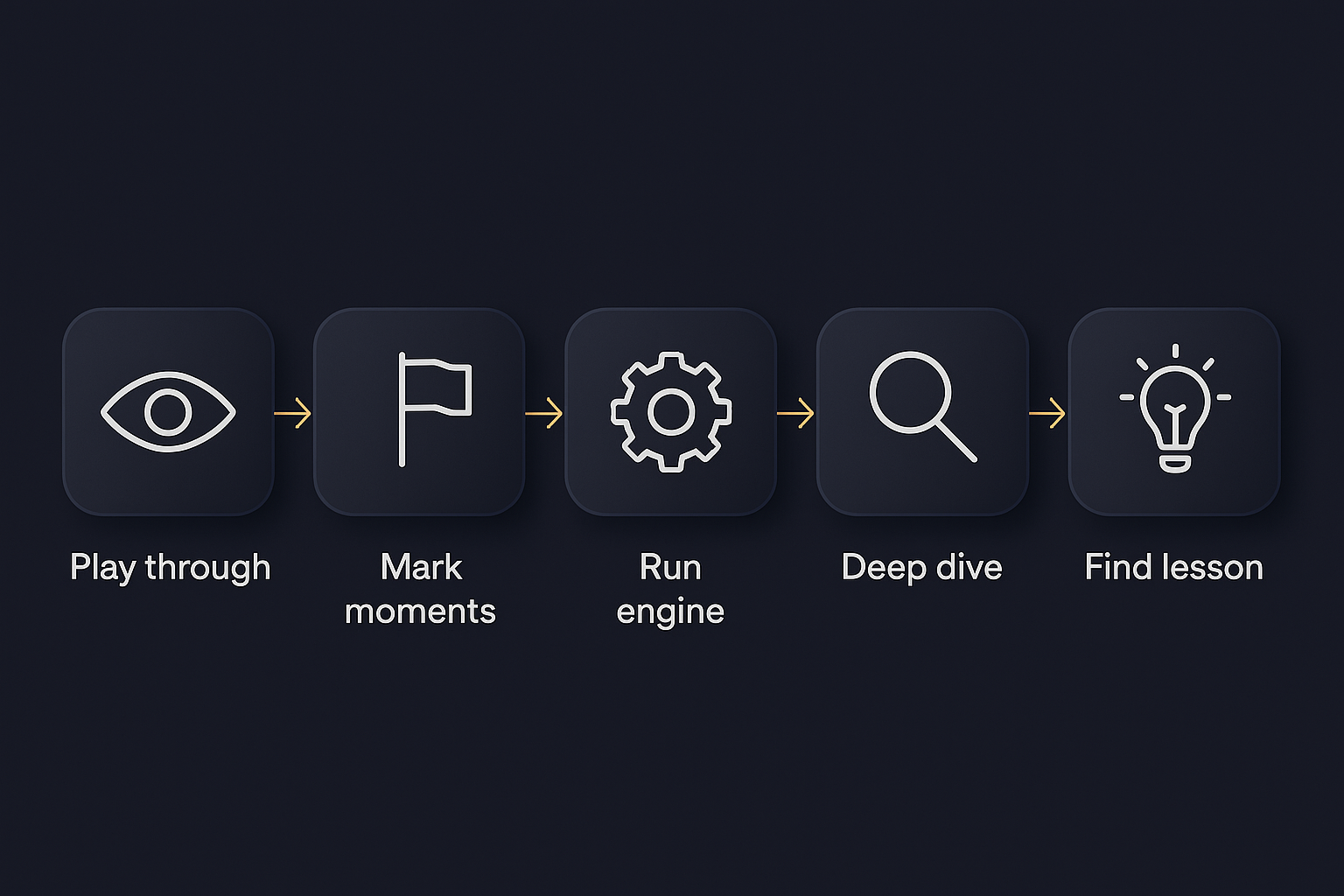
Here’s a concrete process for analysing a game:
1. Play through the game once without stopping (5 minutes) Get the overall flow. Note your general impression.
2. Go through again, marking critical moments (15 minutes) Write down what you were thinking at key positions. What were you trying to achieve?
3. Run the engine and identify evaluation swings (5 minutes) Mark where the evaluation changed by 0.5+ pawns.
4. Deep-dive on 3-5 critical positions (20-30 minutes) For each critical moment:
- What did you play and why?
- What does the engine suggest?
- Why is the engine’s move better?
- What did you miss?
Use Multi-PV analysis to see multiple candidate moves at once—helpful for understanding what alternatives existed.
5. Identify one key lesson (5 minutes) What’s the single most important thing to take from this game? Write it down.
Total: about an hour for a serious game. Not every game needs this treatment—save it for games that felt important or instructional.
Tools that help
Lichess analysis
Free, fast, and shows evaluation after every move. Good for quick checks. The “Learn from your mistakes” feature highlights blunders automatically.
Chessbase / SCID
More powerful analysis tools. You can add your own annotations, compare multiple engines, and build a database of your games over time.
Chessmate
Run multiple engines on your positions to get different perspectives. Useful when positions are strategically complex.
Notebooks
Keep a file of your analysed games with annotations. Reviewing old analyses helps reinforce lessons and shows progress over time.
Try it yourself
Here are concrete exercises to practice this workflow:
Exercise 1: Your last loss
- Take your most recent losing game
- Without the engine, spend 10 minutes identifying the 3 positions where you think you went wrong
- For each position, write down: what you played, what you were trying to achieve, and what you think you should have done instead
- Now run the engine. Compare your identified mistakes to where the evaluation actually swung
- For each real mistake: did you identify it? If not, why did it feel okay during the game?
Exercise 2: Your last win
- Take a game you won convincingly
- Find the moment where your opponent’s position became difficult
- Without the engine: was it a tactical mistake, or did they make a strategic error earlier that you exploited?
- Check with the engine. Were you right about when the game turned?
Exercise 3: The “almost” moment
- Find a game where you were winning but almost threw it away (or did throw it away)
- Identify the critical moment where your advantage was largest
- What did you play? What should you have played?
- This is often more instructive than studying losses—you understand where you need to improve your technique
Summary
Effective game analysis means:
-
Think first, engine second. Annotate without the engine before checking your analysis.
-
Focus on critical moments. Don’t check every move—focus on the positions that mattered.
-
Understand, don’t memorise. Know why moves are good, not just which moves are good.
-
Find patterns. Track recurring mistakes and target them with study.
The engine is a tool for verification, not a substitute for thinking. The more you think during analysis, the more you improve.